The illustrators of the fanzine in dialogue with the Cuban Carteles de Cine
MUSAS, June 1–30, 2024
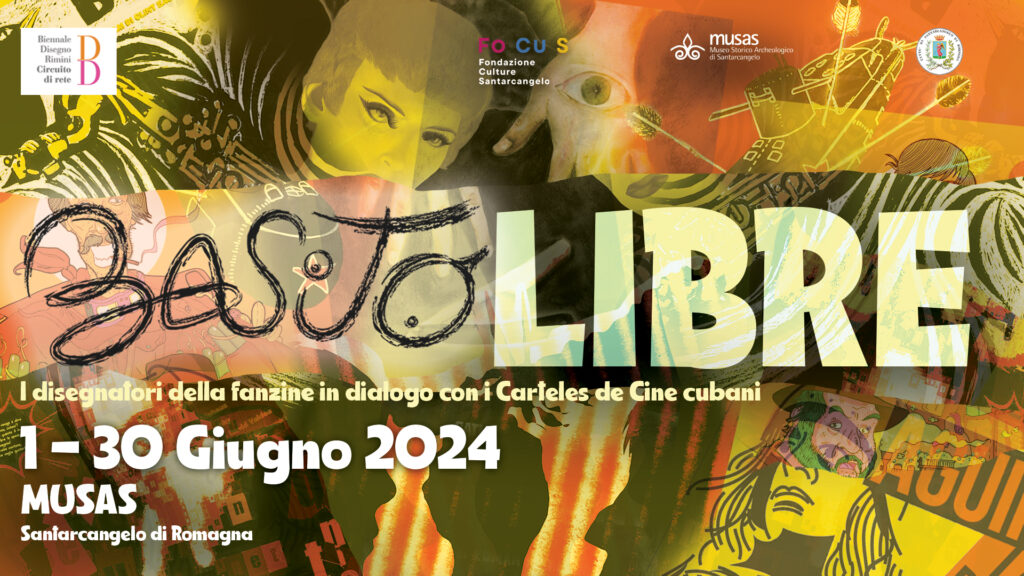
An exhibition project by the Basito collective
In collaboration with Focus – Fondazione Culture Santarcangelo
Curated by Arianna Bargellini
Part of the program of the “Biennale del Disegno Rimini – Circuito di Rete”
Opening hours
Friday, Saturday and public holidays | 4:00 PM – 8:00 PM
Sunday | 10:00 AM – 1:00 PM and 4:00 PM – 8:00 PM
A story of art out of control, of border crossings, of landings on other shores. Closures create desires; restrictions give a name to freedom.
In the 1960s, in Cuba, revolution and embargo: the carteles de cine (movie posters) redesigned auteur films from all over the world.
The fanzine Basito opened its pages during the pandemic lockdown of 2021 in Rimini, as a revolutionary song of artists and writers. Pages like a bundle of wild asparagus, independent sheets that avoid the staple, the space of an exchange.
The Biennale del Disegno 2024 takes on the role of the Cuban ICAIC (Instituto Cubano del Arte e Industria Cinematográficos) with a call to the Basito artists, broadening the scope of an out-of-time dialogue with the carteles de cine and with films of personal cult.
If photography refined the advertising of original posters into a showcase of cinema’s most famous faces, the carteles de cine fight paper with graphic signs, letting an essential feeling, a core sample, set. Fellini’s La dolce vita is not the seductive dance between the gazes of Anita and Marcello, in the blue, red and yellow of market logic, but two black, stripped-bare eyes that speak of the emptiness of an existence.
In the language and colors of this freedom, which is a pact of truth between art and society, speaks the fanzine Basito, conceived by Massimo Modula, and its new project branch, which explores unexplored terrain for the artists. Film advertising becomes asynchronous to the release and gains the status of a pure artistic gesture. Freedom overflows beyond the translation of the film, in this experiment of side effects, and spills a liquid – acidic or nostalgic – that brings a memory to the surface. That liquid is Tarantino’s “good coffee” poured over Simone Genghini’s poster, in pixel concretions; it takes us into the popular pulp of Pulp Fiction, spoken by the balloon of a meme.
The Crying Game (La moglie del soldato) forgets the pulp effect of the original poster, and in the hands of Massimo Modula the scissors of a haircut become the strongest weapon, telling the intimate “what are you willing to do for me?”.
Giuseppe Fogli’s Red October is tatanka, the sacred bison, object of a Native American hunting ritual in the vast prairie of a Sargasso Sea.
The colonnade of St. Peter’s, the Church’s plenary embrace, turns, in Marco Ferreri’s Udienza as seen by Riccardo Maneglia, into an omnipotent, terrifying pincer.
The posters, like the pages of Basito, search for a path and ignite a desire for vision that meets the community at the doors of the Supercinema of Santarcangelo.
A breath of antibodies strikes the pages of Basito, a fever rises and runs through the city, taking its pulse.
If the German Atlantropa project of the 1920s drastically lowered the level of the Mediterranean to generate enormous amounts of hydroelectric energy, Samuele Grassi returns power to nature and floods Rimini with the waters of Panthalassa, infested with Jurassic paganelli that tyrannize the city.
The environment is a generator of thoughts for Basito: the first issue and the specials Coltiva-ti and Fluviale are dense with retting waters, like hemp, with “everything flows”, with life.
Ricky Cardelli enters a sound scene that explodes into Sun Ra’s Nuclear War. The words of the jazz artist resound like a Basito mantra: “I like all sounds that disturb people, because they are too self-satisfied”.
The “nice little drawing about the environment” that the teacher asks of Robertino (Roberto Ballestracci) sets in motion a stream of consciousness that passes through “the featherless pelican drowned in asphalt” and can only give rise to the stereotype “flower”.
Raymond Solfanelli offers a hilarious and edifying historical revision of Hannibal’s victory, thanks to the “smoke” trick, in the glorious Battle of Cannae.
Marica Maggiotti confronts an ornithological mutation, almost a hypertrichosis fairytale by Lavinia Fontana. And thanks to an innate aerostatic ability, Francesco Bocchini’s ugly duckling survives “Being born with unclear features”.
Rimini is the province of a gamebook: the dinosaurs tamed by Ilarius’s Magic Voice, the High Valmarecchia festival in the onion fields of Maiolo announced by Reg Mastice’s Useless Posters, the Morciano of Kipp punk (Chiara Fanelli) that comes apart like a cardboard set from a B-movie.
The feminine step becomes shameless, confined in domestic isolation rooms, with Sabrina Foschini revealing “When I am naked”, in the porno-romantic and propitiatory images of Antonella Piroli.
Massimo Modula coins the currency of Basito’s exchange with the community and portrays its effigies. The Supreme Poet opens issue zero, in Dante’s year, with an emblematic line in answer to the question ideally posed by the fanzine: “Does it ascend or descend?” “Dunno”.
A woman, Sister Rosetta, is consecrated as the mother of rock’n’roll in the special Glory Days. A lucky Al Pacino slides from Scarface onto issue two, discovering with displeasure what is hidden beneath the immaculate snow.
They have sunk their visions into Basito: Sergio Algozzino, Lucia Baldini, Roberto Ballestracci, Maurizio Battaglia, Yuri Bernabini, Ugo Bertotti, Heriz Bhody Anam, Francesco Bocchini, Manuel Bongiorni, Stefano Bruscolini, Maurizio Campidelli, Riccardo Cardelli, Filippo Cesari, Daniela Costantini, Vittorio D’Augusta, Davide Fabbri, Chiara Fanelli, Francesco Ferranti, Giuseppe Fogli, Jacopo Forconi, Sabrina Foschini, Simone Genghini, Umberto Giovannini, Samuele Grassi, Luca Grossi, Federico Guerri, Ilarius, Ermanno Labianca, Lady Vanilla, Daniele Maggioli, Marica Maggiotti, Riccardo Maneglia, Giovanni Marchese, Maria Medea, Denis Medri, Angelo Mennillo, Massimo Modula, Gianluca Morozzi, Mozone, Antonella Piroli, Franco Pozzi, Massimo Pulini, Reg Mastice, Francesco Resca, Paola Russo, Andrea Soleri, Raymond Solfanelli, Carmine Deep Stellaccio.