
Restoration of Paintings
Room VI. Middle Ages and Renaissance houses two of the most important paintings in the MUSAS collection, originally from the Church of San Francesco in Santarcangelo, which no longer exists.
These artworks underwent restoration, funded by the then Institute for Artistic, Cultural and Natural Heritage of the Emilia-Romagna Region, as part of Regional Law 18/2000 – Museum Plan 2006/2008.
Restorations
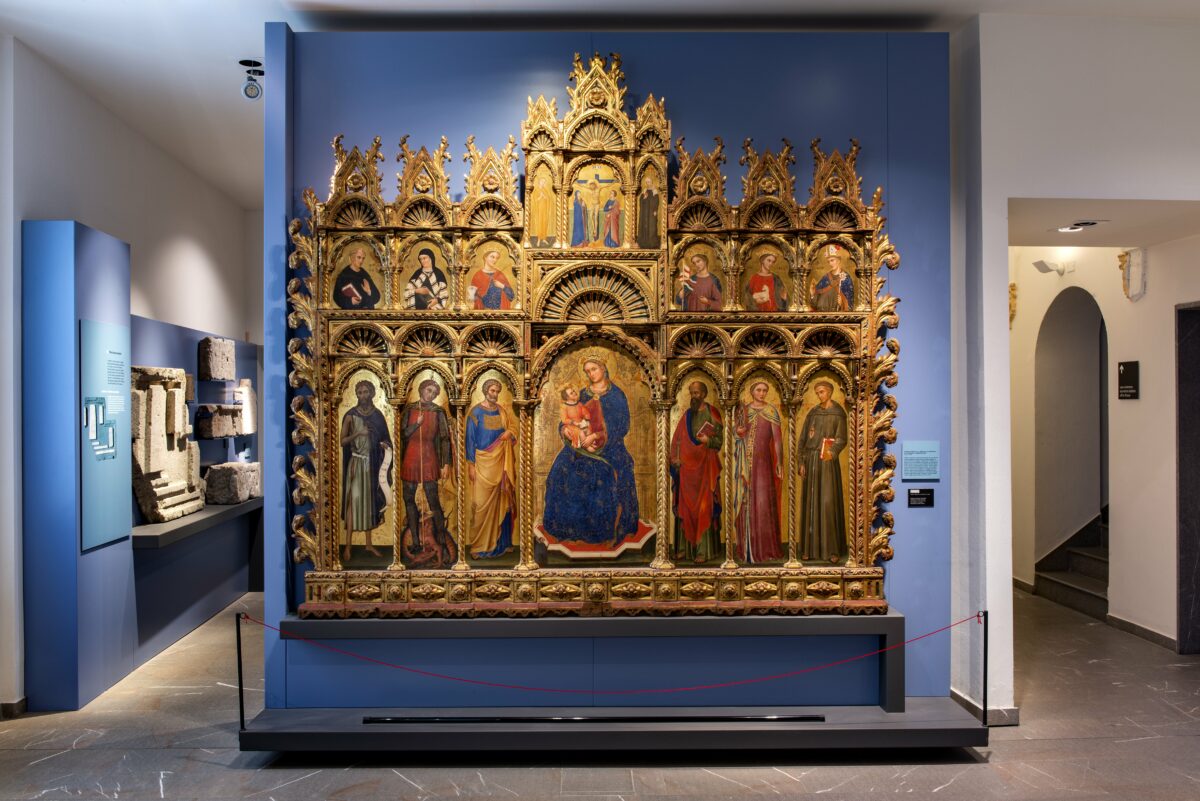
Restoration of the Polyptych by Jacobello di Bonomo
Artwork: The Madonna with Child, the Crucifixion and Fourteen Saints.
Dating: 1385
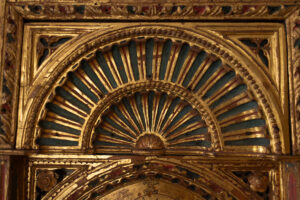
This polyptych consists of sixteen panels enclosed by an opulent, carved and gilded frame, contemporary to the work, and is both signed and dated.
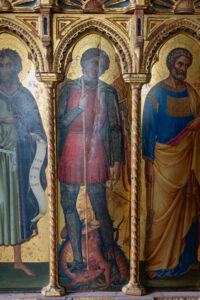
On either side of the central panel, depicting the Virgin with the Child and two donors, are six panels featuring full-length figures of Saints John the Baptist, Michael, Peter, Paul, Catherine of Alexandria and Francis.
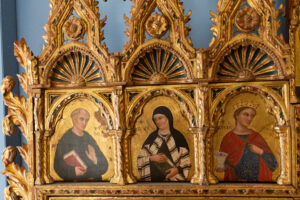
Six additional half-length figures of saints (Anthony of Padua, Clare, Lucy, Ursula, Agnes and Ludovico) are depicted in the upper register, where the central scene shows the Crucified Christ with the Virgin and Saint John, flanked by Mary Magdalene and Saint Elizabeth.
Restorer: Adele Pompili – Bologna
Type of intervention: the maintenance work, carried out in situ without removing the artwork from its location, included an inspection of all painted surfaces and the gilding of the frame, fixing areas of color lift through microinjections of acrylic resin. Numerous restoration fillings had detached from the wooden support; after some adhesion tests, and finding the overall poor adhesion of the support, it was decided to remove them and proceed with new stucco work. The painted surface had four small rectangles of paper attached with a strong adhesive and covered with varnish.
Their function and reason for being there remain unclear. The paper was removed due to the risk that the strong adhesive posed to the painting, as it could cause tears in the paint layer. While maintaining the approach of integrating the gaps with neutral tones, the general tone of the neutral filling was adjusted to a slightly darker and warmer hue than in the previous intervention, in order to visually push back the perception of the gaps.
A tonal reduction was applied to all the new holes caused by woodworm, to help identify any future new holes that could indicate new infestations. A light protective varnish was applied locally over the retouching.
Restoration of the Panel by Luca Longhi
Artwork: Madonna Enthroned with Child between Saints Francis and George.
Dating: 1531
The panel is dated and signed at the bottom left. On the right side, the commissioner, Antonello Zampeschi, is depicted in full armor, kneeling. He held Santarcangelo as a fief from 1530 to 1534. Below, at the center, is the coat of arms of the Zampeschi family.
Restorer: Marisa Caprara – Bologna.
Type of intervention:
- restoration of the painted surface: the protective tissue paper was first removed, followed by the cleaning of the surface to eliminate the thick layer of oxidized varnish, areas of heterogeneous material and drip marks; the protruding and deteriorated stuccoes were then removed, the gaps under the painted surface were consolidated and filled, and the missing areas were re-stuccoed. Afterwards, an intermediate varnish layer was applied by brush, consisting of a thin film of mastic varnish.
For the aesthetic restoration, the filled gaps were connected with the original painting using the technique of color decomposition in short strokes (rigatino). Finally, a protective varnish was applied by spraying with a compressor set at four atmospheres.
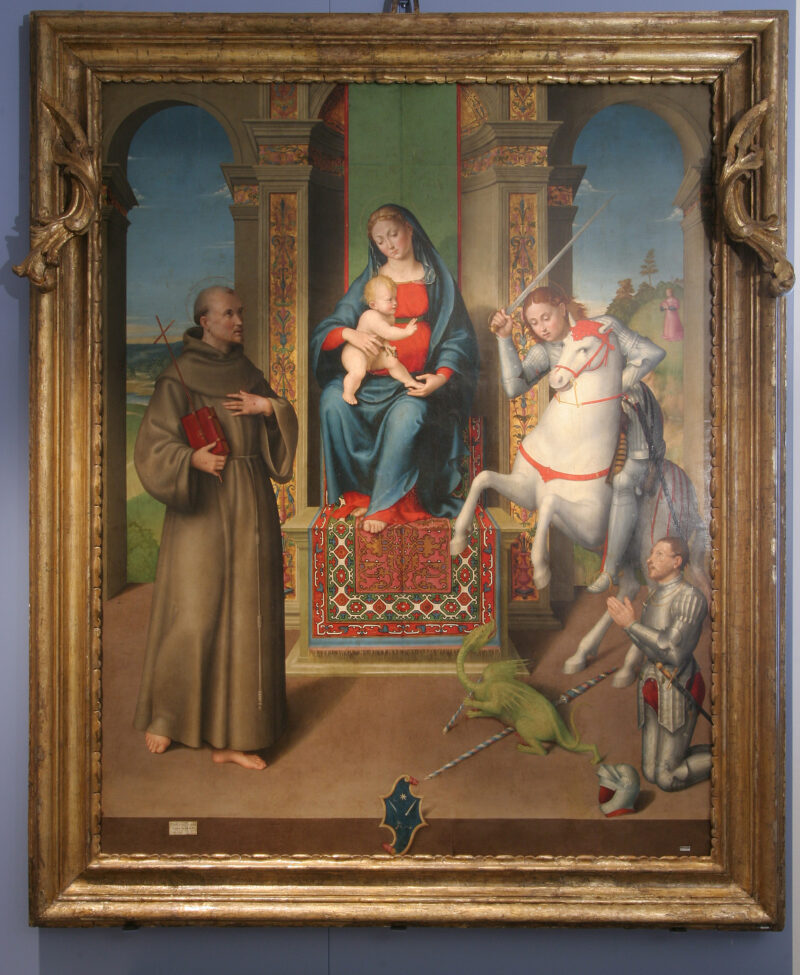
- restoration of the wooden support: the support was cleaned, and cracks along the natural grain of the wood and some disjointed areas between the panels were repaired; the wooden segments were rejoined, the original crossbars were restored, and the wood was treated against insect infestation.