
The History of the Building: Palazzo Cenci
The building that now houses MUSAS, named after the last family to own it, was originally a private and noble residence situated in a symbolic location of the city. It is located within the medieval village of Santarcangelo, which is itself a true monument of historical, artistic, urban, and environmental significance. Specifically, Palazzo Cenci stands between the first and second circles of the Malatesta walls, overlooking Piazza Monache, which for centuries was the heart of the town’s life. It is also close to Porta Cervese, one of the main entrances to the village in medieval times.
Few documents describe the history of the building, making it difficult to reconstruct its exact construction history, which is complicated by the fact that its construction occurred in successive stages.
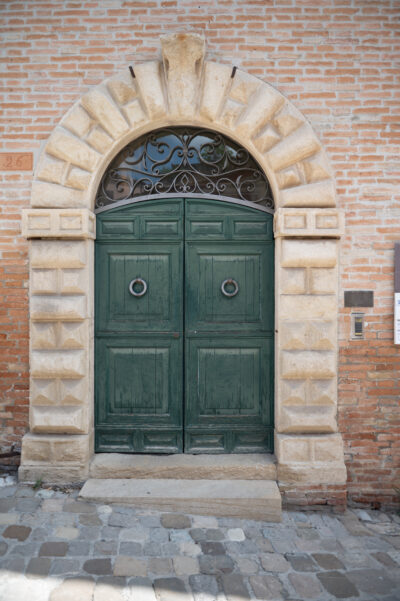
The first phase, which likely dates back to the 17th century, is responsible for the construction of the palace in the section facing Via della Costa, with the white ashlar portal that is now the museum entrance. Next to the entrance, two windows are covered by wrought-iron grilles shaped like lilies.
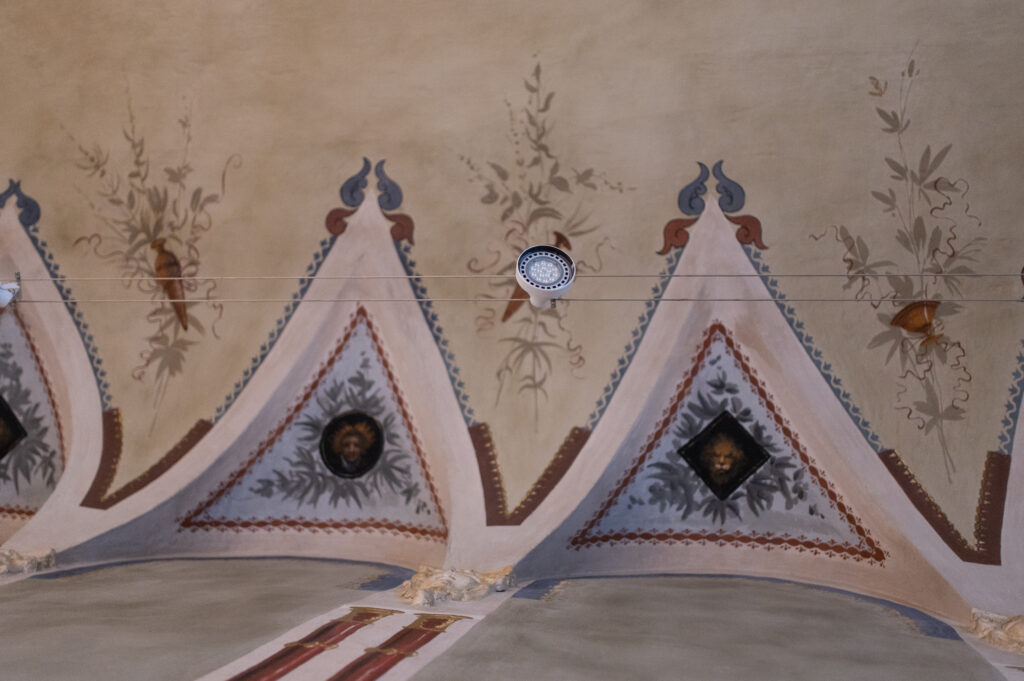
This phase is followed by the late 18th to early 19th century, which relates to the rear section of the building on Via dei Fabbri, where it was expanded and provided with another entrance. The frescoes that still adorn the rooms of the so-called Piano Nobile (on Via della Costa) and the corridor, where the museum’s historical-artistic path now unfolds, date back to this period.
Palazzo Cenci remains one of the monuments that testify to the intense building activity Santarcangelo underwent during those centuries.
After its purchase by the municipality, in the 20th century the building served various functions, including as a lazaretto for the treatment of cholera patients, until the restoration in the 1980s.
Since 2005, it has hosted the MUSAS galleries, which are developed across five levels.
From Room 1. The Furnace, access opens to a small private grotto of the palace.