
The Museum, an Ongoing Exploration
Research in the local area has been the foundation for the gradual formation of the MUSAS collection and remains the driving force behind its continuous development, aiming to engage not only the scientific community but also a wider audience.
The scientific dialogue and in-depth research, which are integral to the museum’s activities, position MUSAS within a network of other museums, cultural institutions and research centers, with the goal of fostering new collaborations.
Loans
The museum’s loan activities contribute to the development and understanding of its collection, while ensuring the preservation and accessibility of the objects.
For more information about loan procedures, please contact the museum’s management.
Studies
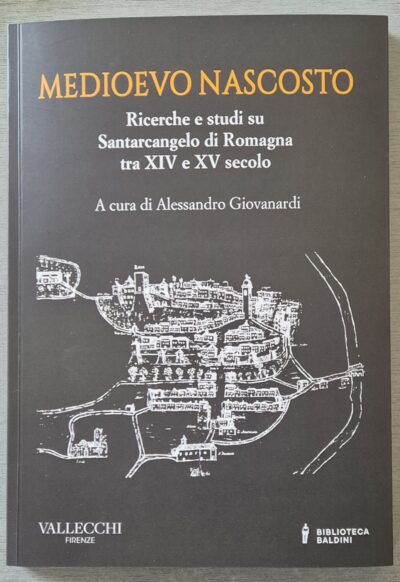
Medioevo nascosto: the study of the 1385 Polyptych
The Polyptych by Jacobello da Bonomo, housed at MUSAS, is one of the main subjects of the art-historical study published by Alessandro Giovanardi in the book Medioevo nascosto, which focuses on the recent discovery and enhancement of the “Casamatta” site near the ancient Porta di San Michele Arcangelo, and its fascinating works of art from that period.
Among these works is the “masterpiece by Jacobello da Bonomo”, which the art historian examines from its historical context to its artistic, technical and iconographic aspects, providing a further tool for understanding and appreciating the work during visits.
Medioevo nascosto: ricerche e studi su Santarcangelo di Romagna tra XIV e XV secoli
edited by Alessandro Giovanardi
2023 – Vallecchi Firenze – Biblioteca Comunale Antonio Baldini, Santarcangelo di Romagna
A Roman Era Market Calendar
In 2022, MUSAS launched a research project focused on a small yet significant artifact discovered at the Pieve di San Michele Arcangelo in 1846, entrusting its study to the archaeologist Filippo Coarelli.
The original engraved terracotta plaque, less than 10 cm tall, is currently housed and displayed at the “Luigi Tonini” Museum in Rimini, where it was delivered upon its discovery, while MUSAS displays a cast.
The plaque is a fragment of a calendar of weekly markets, possibly dating back to the Republican era, indicating markets held in the region and reflecting Santarcangelo’s role as a place of exchange, which has continued uninterrupted from ancient times through the Middle Ages and the modern era.
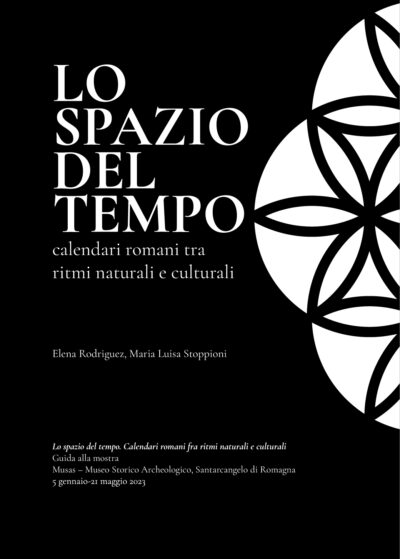
The study provided the opportunity to design an exhibition dedicated to the history and types of calendars used in the Roman era as tools for marking the passage of time.
Lo spazio del tempo. Calendari romani tra ritmi naturali e culturali, exhibition guide
edited by E. Rodriguez, M.L. Stoppioni
2023 Maggioli Editore
A bit of bibliography between art and archaeology:
General contributions:
Studi santarcangiolesi, in «Studi Romagnoli» XXXIV (1983), Bologna 1986, pp. 3-455.
M. Biordi, S. Nicolini, M. Turci, Guida per Santarcangelo, Rimini 1986.
Studi su Santarcangelo, in «Studi Romagnoli» LVI (2005), Cesena 2007, pp. 11-289.
M.L. Stoppioni, P.A. Fontana, M. Turci, A.M. Baravelli, Storia di Santarcangelo di Romagna, Rimini 1999.
R. Giannini, Santarcangelo di Romagna, Verucchio 2023.